
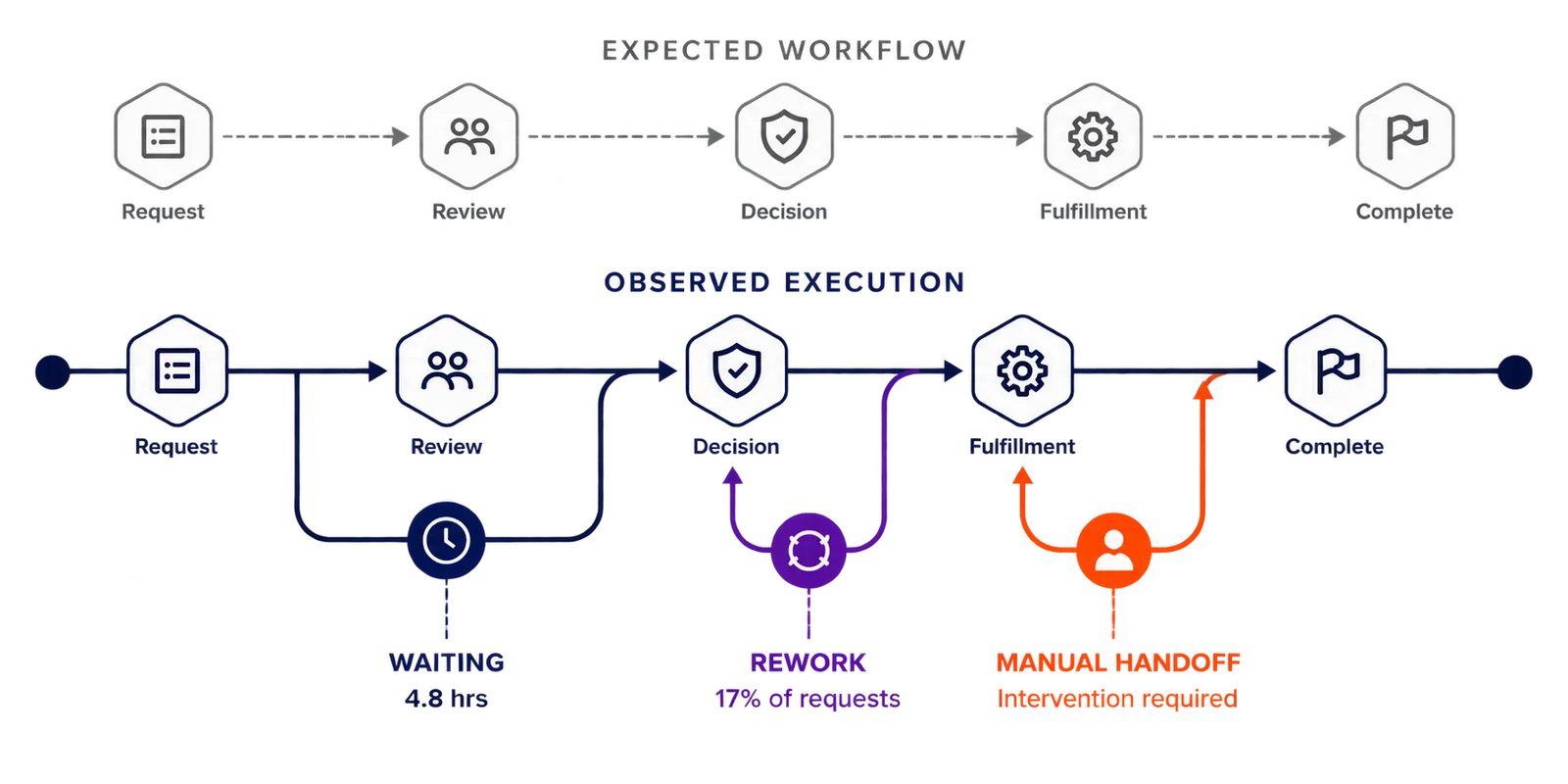
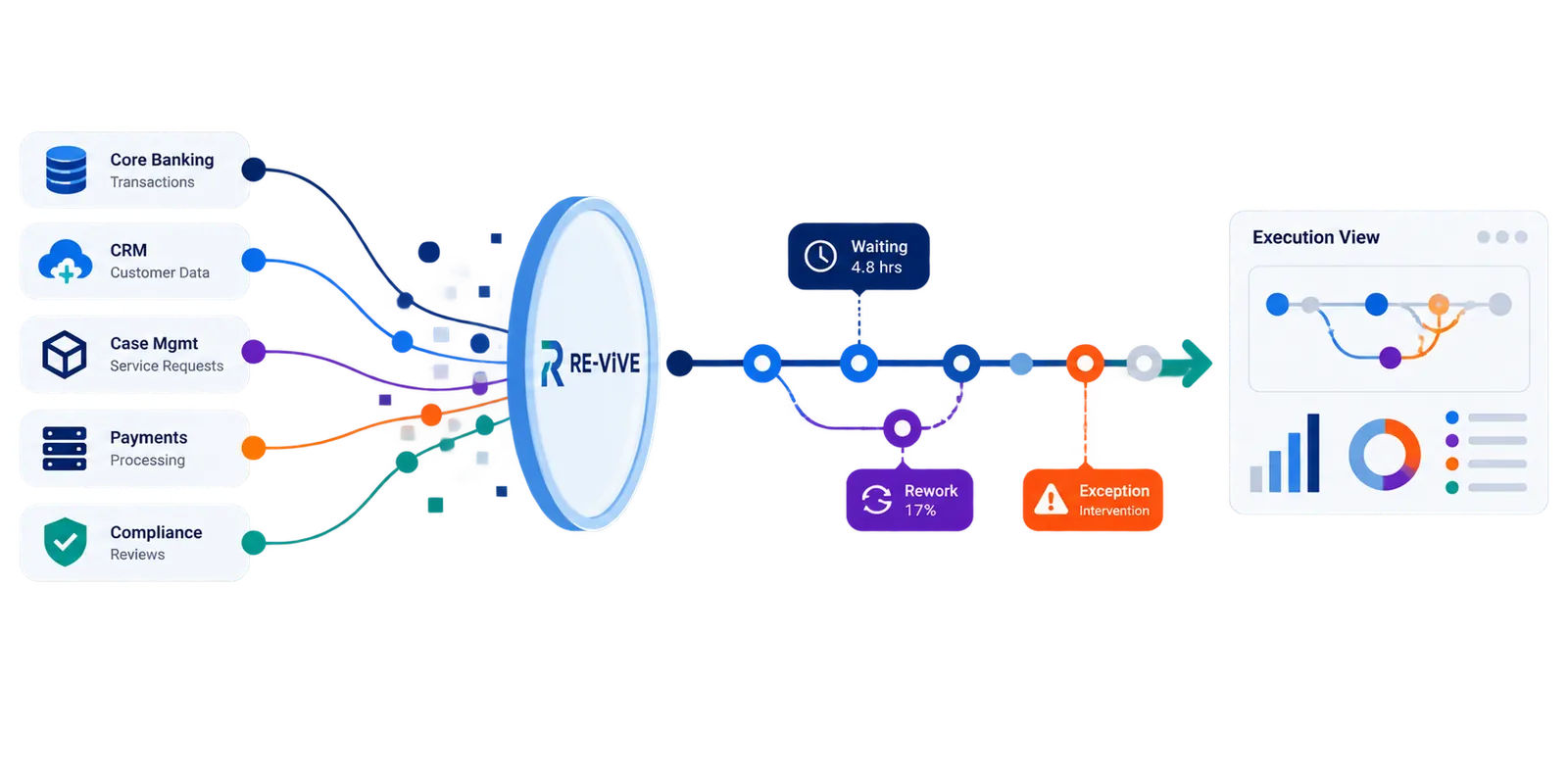

One execution reality. Different stakeholder lenses.
Commercial customer onboarding is one example. The underlying execution is the same; the questions change depending on who is looking.

Why Banking Is Different
Critical workflows often cross core platforms, CRM, workflow systems, portals, files and legacy applications.
Policies, controls and review requirements evolve while the underlying operation must continue to execute.
Access, privacy, residency and security expectations limit how aggressively new technology can touch production environments.
Operations and technology teams are already balancing regulatory, customer, transformation and run-the-bank priorities.
Banking work moves between people, approvals, systems, automation and exception handling in ways dashboards rarely show.
Process changes can affect customer experience, controls, service levels, cost and operational risk at the same time.
Banking workflows differ, but the execution questions are remarkably similar. These are representative examples—not a fixed workflow library.
Examples: KYC/KYB · Documentation · Approvals · Account Setup
Examples: Payment Processing · Exceptions · Investigations · Repair
Examples: Application · Underwriting · Approvals · Closing
Examples: Service Requests · Case Management · Exceptions · Escalations
Examples: KYC/AML Reviews · Investigations · Approvals · Remediation
Examples: Trade Processing · Exceptions · Settlement · Reconciliation
The best candidates are not always the largest processes. They are the ones where important execution is difficult to see end to end.

What Banks Can See Differently
Two requests can both be completed, meet an SLA or reach the same customer outcome while taking materially different paths through reviews, systems, approvals and exceptions.
The value of Execution Intelligence becomes clearest when the bank does not already have a clean, documented process model to work from.
The bank needed to understand nearly 100 service workflows and reduce SLA exposure, but the execution evidence was fragmented across Excel files, workflow platforms and custom applications.
Enough to establish source context and business meaning—without documenting every workflow first.
Execution evidence was organized into observed runtime paths across multiple operating environments.
The bank could begin seeing execution, SLA behavior, variants and intervention patterns quickly.
Start with the execution evidence already being created by the systems, teams and controls involved in the work.
Banking Execution in Practice

A meaningful share of onboarding work moved through additional reviews, handoffs and repeated activity.
Identify which conditions create unnecessary paths and where work can be standardized or simplified.
Lower manual effort · shorter onboarding time · more predictable service · improved customer experience
Repeated correspondence, review loops or exceptions concentrated work in particular execution paths.
Target the conditions creating repeated work rather than redesigning the entire process.
Recover capacity · reduce avoidable cost · improve SLA performance
Requests reaching the same outcome could pass through materially different approvals, handoffs or control paths.
Focus control reviews where execution differs from intended policy rather than reviewing everything equally.
Stronger control assurance · targeted remediation · lower compliance exposure
Business customer onboarding
Follow the customer story, explore a real product walkthrough and see what starting with one journey involves.
Commercial customer onboarding is one example. The underlying execution is the same; the questions change depending on who is looking.
